Similar brand names, different bottle sizes, and changing packaging can make online product information confusing. For products commonly called “poppers,” a familiar name or label design does not tell you everything about the specific item.
The useful starting point is to compare the bottle’s label with the listing and verified manufacturer information. This guide explains which details to check, how to investigate discrepancies, and what packaging alone cannot establish.
What Information Should You Check on a Poppers Label?
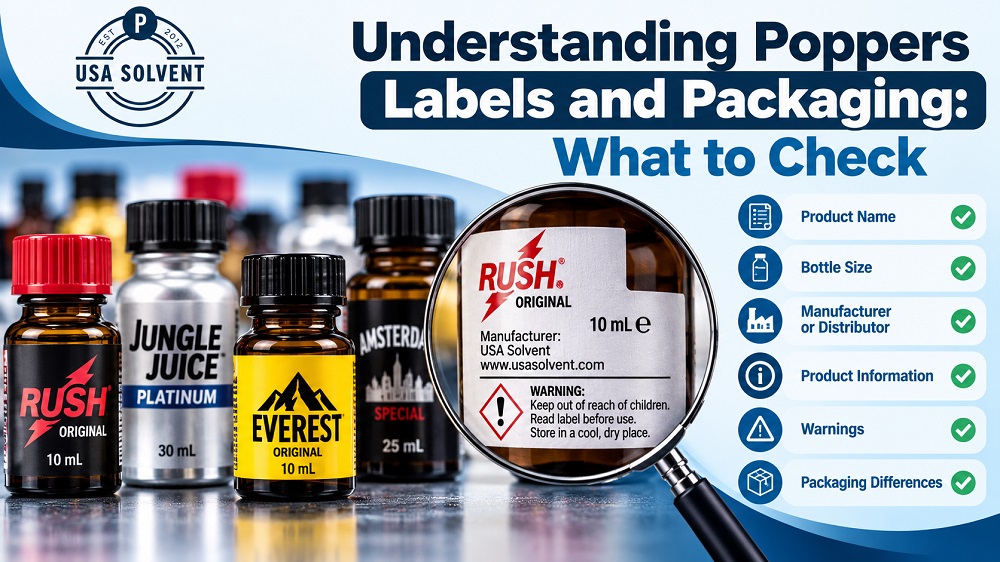
Look for the following details where provided. If information is missing, ask the supplier or manufacturer rather than making assumptions.
| Label detail | What to check |
| Complete product name | Does it match the listing, including any named version? |
| Bottle size | Does the stated volume agree with the photograph and selected option? |
| Manufacturer or distributor | Is the company identified clearly? |
| Product information | Is the description consistent with documented manufacturer information? |
| Warnings | Are handling and storage instructions readable? |
These details help identify what is being presented. They do not independently establish authenticity, or safety.
Check Bottle Sizes Against the Product Listing
Bottle size is a straightforward detail to verify, but listings can create confusion when photographs and descriptions differ.
For example, a page might display a 10 mL bottle while the selected option states 30 mL. That discrepancy needs clarification; the photograph alone cannot establish which size will be supplied.
Check the product title, size selector, written description, and bottle label together. They should describe the same item or clearly explain any differences.
Compare Product Photographs With the Label
A useful product photograph should make the name, bottle size, and relevant label information legible.
If the image shows a different version from the description, ask which exact item the listing represents. If it shows older packaging, ask whether that photograph is current and whether the manufacturer has confirmed the change.
Do not infer contents from the bottle’s color, cap, or shape. Those features can help identify a discrepancy, but they cannot verify the formulation inside.
Does Different Packaging Mean Poppers Are Counterfeit?
Different packaging does not automatically prove that a product is counterfeit. Equally, a convincing label does not prove that it is authentic.
Check whether:
- The complete product name remains consistent.
- The manufacturer or distributor details match.
- The bottle volume agrees with the listing.
- The supplier can explain the difference with supporting information.
Our guide to identifying authentic poppers and avoiding counterfeit products discusses packaging discrepancies and seller information in more detail. Authenticity and safety remain separate questions.
Can Brand Names or Label Colors Identify Ingredients?
A brand name or label color is not a reliable substitute for product-specific composition information. Similar-looking bottles do not establish that their contents are identical.
Where ingredient information is supplied, confirm that it applies to the exact product and version concerned. Another retailer’s description of a similarly named item may not resolve the question.
An applicable safety data sheet can provide further information about composition, hazards, handling, and storage. Check that the document corresponds to the specific product.
How to Interpret “Original,” “Premium,” and “Strongest”
Promotional language often provides less information than a documented specification.
“Original” may be part of a product name, but it does not independently confirm authenticity. “Premium” does not establish a defined quality standard. “Strongest” does not establish safety or suitability.
Look for a clear explanation and supporting information instead of relying on an adjective.
Read Handling and Storage Instructions
Keep chemical products in their original containers, away from children, and follow applicable handling and storage instructions. Do not transfer them into food or beverage containers.
Nitrite products commonly called “poppers” should not be ingested or intentionally inhaled. The FDA’s advisory on nitrite poppers warns that these exposures can cause serious injury or death.
What to Do If the Label and Listing Disagree
Give the supplier a specific discrepancy to investigate. Include the complete product name, bottle size, relevant photographs, and any batch information available.
For example:
“The description names one version, but the photograph shows another. Which exact product is being supplied, and is the image current?”
For questions about a USA Solvent listing or an item received, contact USA Solvent customer support with the relevant details and your order number, if applicable.
Avoid handling a leaking or damaged bottle simply to obtain photographs. Describe the issue to the supplier and seek appropriate handling guidance.
Frequently Asked Questions About Poppers Labels and Packaging
Does a different label mean a product is fake?
Not necessarily. It may represent a different product or a packaging change. Seek confirmation rather than judging authenticity from appearance alone.
Can I identify ingredients by label color?
No. Use verified composition information for the specific product.
What if the photograph and description show different bottle sizes?
Ask the supplier to confirm the volume and exact item being supplied.
What should I ask when packaging changes?
Ask whether the image is current, what changed, and whether the manufacturer has confirmed the new packaging.
Use Specific Information to Resolve Uncertainty
Reading poppers labels is most useful when it helps identify a precise question: a different name, an inconsistent bottle size, missing warnings, or an unexplained packaging change.
Compare those details with verified manufacturer information and ask for clarification when needed. Familiar branding and promotional claims cannot replace product-specific documentation.
About Author

